
In my most recent Substack post, Canadian Wildfires, A Long View & A Bear View, I consider the fires burning across parts of Canada, now in July 2026 — about 2.8 million hectares so far, on or below long-term averages — through the lens of forest ecology, carbon dynamics, and the absurdity of treating these ecosystems as reliable sinks for Net Zero accounting.
All living things breathe, and forests are no exception. Trees and vegetation take in carbon dioxide during photosynthesis — the ‘inhalation’ that builds biomass and stores carbon — while releasing oxygen as the byproduct. In turn, animals and humans inhale oxygen and exhale carbon dioxide, releasing stored carbon when we metabolise food or exercise at the same time burning fat and carbohydrates. The boreal forests of Canada do something similar on an ecosystem scale and across the millennia: they sequester carbon during growth phases but release it through respiration, decay, and especially fire — the natural ‘exhalation’ that recycles nutrients and resets the landscape.
When large areas burn, stored carbon — including in peat accumulated over centuries— returns to the atmosphere in a pulse, just as we exhale more CO2 during intense activity. This dynamic exchange has operated for millennia in the Canadia forests, but with more storage during the earlier periods of this current geological epoch known as the Holocene.
Peat itself is fundamentally soil derived from once-living matter. It consists of partially decomposed remains of plants — primarily sphagnum mosses, sedges, reeds, leaves, roots, and woody debris — that have accumulated over centuries to millennia in waterlogged, oxygen-poor conditions. In boreal forests and wetlands, this material builds up layer upon layer because cold temperatures and saturation slow the activity of decomposers (bacteria, fungi, and invertebrates) to a fraction of their normal rate. What we call ‘peat soil’ is therefore not mineral earth in the usual sense, but a vast archive of organic carbon that was once part of living vegetation. Over thousands of years, this slow transformation turns the products of photosynthesis into one of the largest long-term carbon stores on the planet — a legacy that gives boreal ecosystems their outsized role in the global carbon cycle.
These boreal forests that span such a vast expanse of the Northern Hemisphere, are also known as taiga: from the Russian ‘тайга (pronounced roughly ‘tie-ga’), which itself was borrowed from the Yakut (Sakha) people of Siberia, where it means ‘dense forest’ or ‘forest of the mountains’ (from Turkic/Mongolic roots referring to forested or mountainous wilderness). It entered scientific and popular use in the 19th–early 20th century through Russian explorers and naturalists describing the vast northern forests of Siberia.
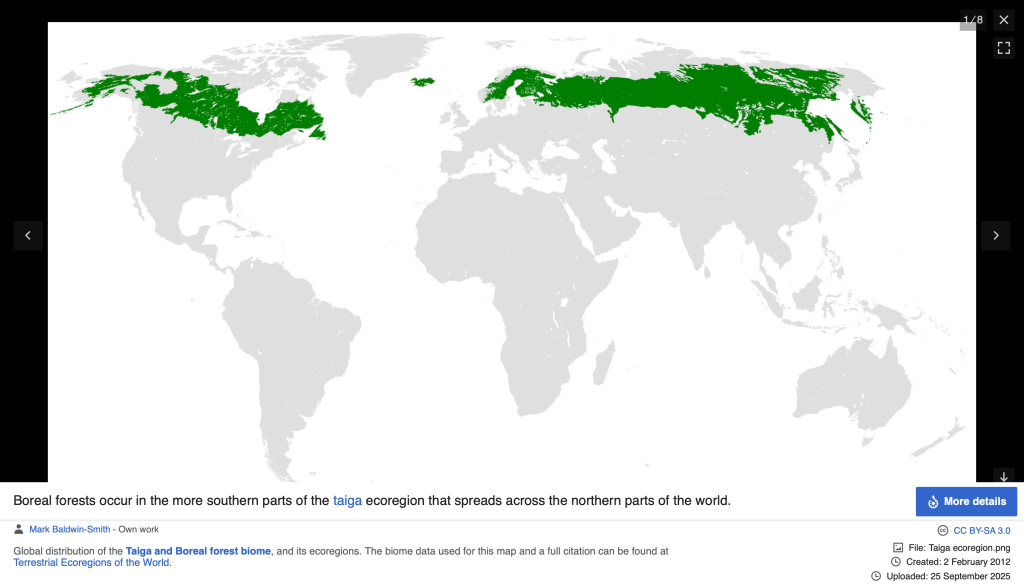
This forest biome we see today is near its maximum extent for the current interglacial period.
During the Last Glacial Maximum some 20,000–26,000 years ago, massive ice sheets covered much of northern North America and Eurasia, restricting the extent of the forests and their component species to fragmented southern refugia. The biome was dramatically smaller — perhaps only 20% of its present area, or roughly one-fifth the size of today’s vast northern forests.
As the ice retreated at the end of the Pleistocene and the Holocene epoch began around 11,700 years ago, the tree line moved north, rapidly expanding. By the mid-Holocene, during warmer conditions, the biome had grown to something approaching or locally exceeding its modern area. The current global extent of roughly 17 million square kilometres is probably the largest the boreal forest has achieved since the previous interglacial; the Eemian, around 130,000–115,000 years ago.
This post-glacial expansion — a roughly 5-fold increase in area from the depths of the last ice age — allowed the accumulation of the deep peat and soil carbon stores that characterise many boreal regions today. Much of that carbon was fixed by vegetation over the subsequent millennia under relatively stable Holocene conditions. Understanding this history is important because it shows the boreal is not a static, ancient forest but a dynamic, migratory biome that has repeatedly contracted and expanded with natural climate cycles.
Today’s large extent and substantial carbon stocks therefore represent a relatively recent Holocene high point — one that is perhaps now in decline, as all living things have a lifecycle.
Boreal forests, like many natural ecosystems, follow a recognisable lifecycle that includes a climax phase — a mature, old-growth stage in which net carbon sequestration typically slows or approaches equilibrium. After a major disturbance such as fire, the stand regenerates vigorously, acting as a strong carbon sink for decades as young trees and vegetation grow rapidly. Over time it matures, biomass peaks, and annual uptake declines as respiration and decay balance much of the new growth. In this climax or late-successional state, the forest can still hold enormous carbon stocks (especially in soils and peat), but there is no overall net addition to this reserve.
In parts of Canada and other boreal regions, decades of fire suppression, combined with natural aging of post-glacial stands, have increased the proportion of older, mature forest. This shift toward more climax-like conditions is one reason some analyses suggest the overall carbon sink strength of managed boreal forests has weakened in recent decades — the system is moving into a new phase.
This has significant implications for the financial markets based around the notion of Net Zero and carbon sequestration to limit human-caused climate change.
- Over-Reliance on Annual Sequestration Numbers
Carbon credits and Net Zero claims often rely on projected annual sequestration rates (e.g., the hundreds of TgC/yr cited for Canadian forests in good years). The boreal lifecycle shows these rates are highly variable over decades and centuries. Mature/climax stands sequester less per year, and episodic fires or thaw can turn sinks into sources quickly.
Bankers packaging forest offsets as reliable, long-term assets are therefore selling a product whose underlying performance is less predictable than assumed. This introduces material risk to credit integrity and market valuations.
- Permanence and Additionality Challenges
A core requirement for high-quality carbon credits is permanence (carbon staying stored for decades to centuries) and additionality (extra sequestration beyond what would happen anyway). Boreal peat and old-growth carbon stocks represent centuries-to-millennia of accumulation, but they are vulnerable to fire, drought, and warming associated with natural climate change. When credits are issued based on avoided logging or enhanced management in fire-prone areas, the risk of reversal (e.g., a large burn releasing the credited carbon) is significant. This undermines the ‘offset’ value and exposes buyers (and the banks facilitating the trades) to accusations of greenwashing.
- Market and Financial Risk
Wall Street has poured capital into nature-based solutions, REDD+, voluntary carbon markets, and ESG funds that lean heavily on forest sinks. If boreal (and similar high-latitude) systems are at climax or shifting toward net source behaviour, the assumed sink capacity baked into portfolios and derivatives could be overstated. This creates potential for stranded assets, repricing of carbon credits, and regulatory scrutiny. Investors betting on ‘natural climate solutions’ as a growth sector may face downward revisions when fire seasons or thaw events repeatedly demonstrate the dynamic nature of these stores.
- Policy and Accounting Implications
Net Zero strategies assume forests and land use can reliably deliver large, ongoing removals to balance residual emissions. The longer Holocene/peat perspective suggests that in mature boreal regions, the easy sequestration gains may already have been realised, and future net removals could be smaller or negative under continued warming. For bankers structuring deals or advising governments, ignoring millennial-scale lifecycles and latitudinal realities risks building financial products on optimistic assumptions that the paleo and disturbance record do not support.
Considering the longer view, the taiga biome’s lifecycle is not as the financial markets pretend. In fact, these forests are unsuitable for the simplified, annualised accounting that underpins carbon finance.
Wall Street’s involvement in these markets is profitable only while the narrative holds.

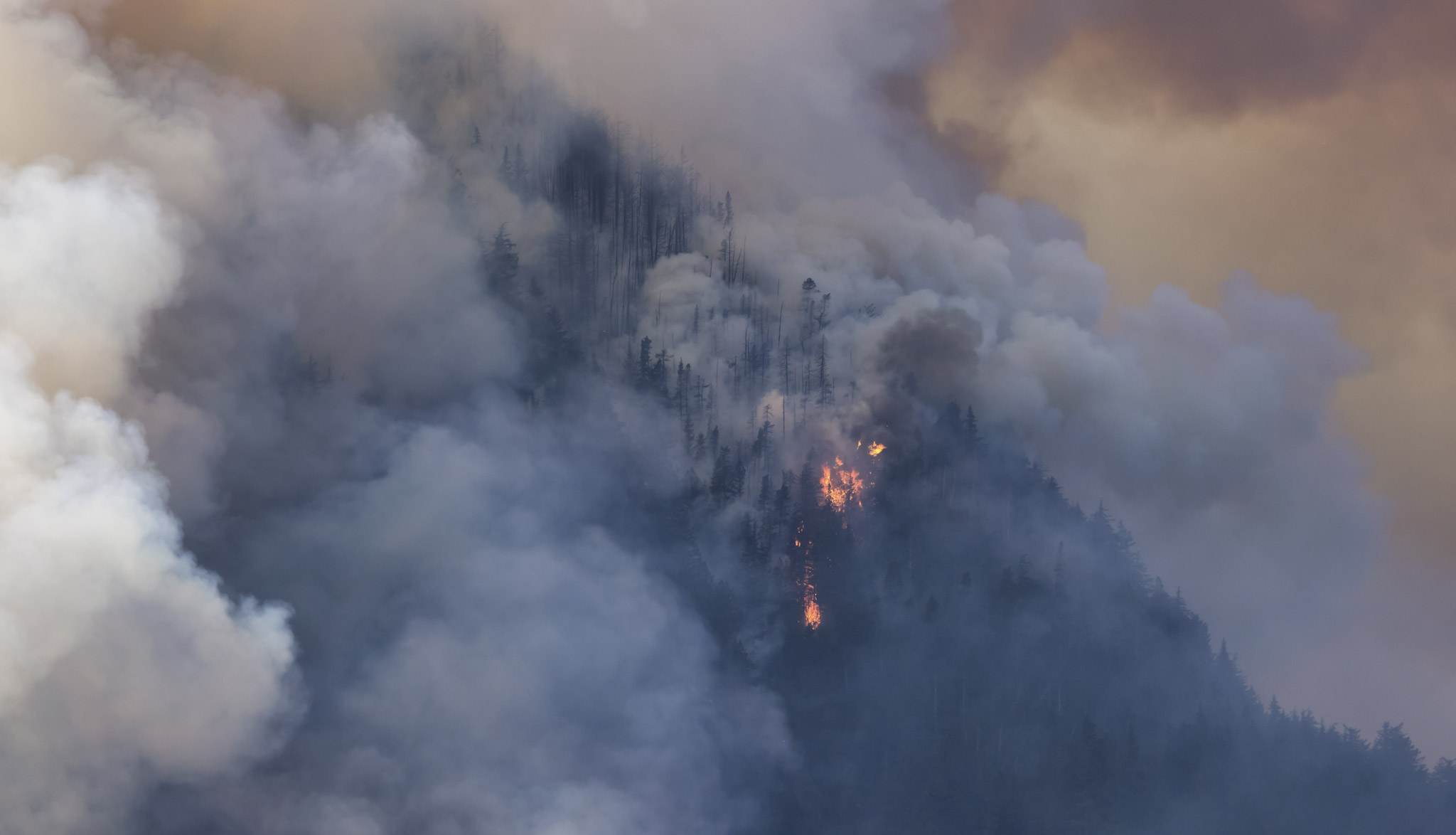
The map showing the global extent of the taiga/boreal Forests is by Mark Baldwin-Smith . The photograph is of a forest fire in British Columbia, Canada.
 Jennifer Marohasy BSc PhD is a critical thinker with expertise in the scientific method.


People push Net Zero in the mistaken belief that man-made carbon dioxide emissions carry a danger of harmful global warming. There is no such danger. Carbon dioxide emissions can cause a contributory warming no greater than perhaps 1.2°C . That would be scarcely detectable with available methods. It is less than the usual 1.5°C of contributory warming that is often said to be practically negligible.
Atmospheric carbon dioxide is an essential nutrient for plant growth, which comes into this in three ways: more plant growth enhances carbon storage as peat, which is a contributory factor to removal of carbon dioxide from the atmosphere; and it increases the amount of transpiration that contributes to cooling of the land. At present, there is some global warming due to factors other than CO2 emissions, and, as Jennifer points out, such warming may partly counter the enhancement of peat storage due to CO2 emissions, by making peat release some of its carbon content back into the atmosphere.
These effects are of relatively small magnitude. It is dismal to see people financializing them, and diverting investment from the productivity necessary for human happiness. Such productivity is best achieved through reliable and safe electricity generation by such means as coal and gas fired power stations, and perhaps by nuclear power. It should be unnecessary for Jennifer to spend time pointing out the particular practical problems of Net Zero.
Thanks Jennifer. Very interesting explanation of the impact of forests and implication for Net-zero and carbon tariffs.
When are folks going to realise that CO2 helps plants grow and is not the cause of Global Warming / Climate change. For the last 30 years this myth has been promoted.
What historians will definitely wonder about in future centuries is how deeply flawed logic, obscured by shrewd and unrelenting propaganda, actually enabled a coalition of powerful special interests to convince nearly everyone in the world that CO2 from human industry was a dangerous, planet-destroying toxin. It will be remembered as the greatest mass delusion in the history of the world – that CO2, the life of plants, was considered for a time to be a deadly poison.
Richard Lindzen probably the worlds greatest living meteorologist.
The wet sclerophyll forests of eastern Australia are much smaller in extent than the boreal forests and have insignificant areas of peat swamps than boreal of tropical rainforests. However, the potential for large emissions from high intensity megafires was demonstrated in Victoria on Saturday 7 February 2009.
The late Dr Kevin Tolhurst, in evidence to the 2009 Victorian Black Saturday fires gave a clear view on the CO2 emissions potential in one bad day.
He stated: “The total amount of heat released from the fires on “Black Saturday” would have been sufficient to provide the total energy needs for all Victorian domestic and industrial use for a year. This energy was released in just a few hours. The energy of the fires was equivalent to more than 1500 atomic bombs the size of the one used at Hiroshima, which devastated an area equivalent to 2,000 ha, but bushfires release their energy in a “storm” not a “blast”. This gives an indication of the destructive power of these fires.” See page 14 at the link below.
http://royalcommission.vic.gov.au/getdoc/5905c7bb-48f1-4d1d-a819-bb2477c084c1/EXP.003.001.0017.pdf
The potential risk that high intensity megafires pose to sale of reliable carbon credit units (CCUs), allegedly generated by the Improved Native Forest Management (INFM) method, does not seem to have been seriously considered by the method’s proponents. The millions generated by sale of CCUs will be used to finance the north east NSW great koala national park proposal.
It is understood that the INFM method does not account for bushfire emissions. The emissions from “natural” events, mustn’t contribute to global CO2 levels. However, emissions from low intensity, planned burns will be counted, thus reducing the number of carbon credit units that can be sold. This logic will ensure mitigation is minimised and the risk of a Black Saturday event will grow with each passing year.
The INFM method has been ticked off by the state and federal politicians and carbon and environment agencies. This is just one of many examples of “science” being used to satisfy political objectives. The process highlights yet again, why there is a desperate need for independent federal and state research integrity bodies to review science that underpins key government policies.
Well said, Peter Rutherford. The foolish doctrine of harmful man-made carbon-dioxide-emissions global warming is used to financialise large-scale bureaucratism, a threatening but camouflaged version of global communism.
Well said, Brian Combley.
Well said, Barbara Sheppard.
Huge, “locked-up” stands of mature connifers?
“Catching fire”?
Who da thunk it?
Under-storey “fuel load”? See also: Oz.
Briskly-moving LOW INTENSITY fires are actually not just “beneficial” to forests, but, in the case of Eucalyptus species, NECESSARY for germination of the hardy seed pods. “Fire Climax” is the term for such species.
TOO MUCH understorey litter and the heat from a fire will “cook”, not just the seed pods, but “ring-bark mature trees and burn-out the underground biome that is loaded with bacteria, fungi and assorted creepy-crawlies that mulch it all together.
Broad-acre, super-hot fires open up the soil to the sky and its constant traffic of airborne wildlife, for better or for worse.
Quite often, as these fires tend to create their own “weather zone”, rain will follow the fire, cheerfully washing away the sterilized remains of remnant top-soil. Clogging waterways, suffocating aquatic life, etc..
All is NOT “sweetness and light” out there in “Gaia-Land”. But it MUST be intrinsically “good”, right? Because; “NATURE”?
Jennifer,
If there was a *like * button I would press it. 🙂