Since 1996 the Bureau of Meteorology has been replacing liquid-in-glass thermometers with electronic probes connected to automatic weather stations. The probes do not measure temperature directly; they measure electrical resistance, which is converted to a temperature value. That conversion is only as stable as the voltage supplied to the sensor.
At remote stations the power is often supplied by ageing lead-acid batteries. When those batteries are asked to do extra work—such as powering a satellite transmission—the voltage drops and the recorded temperature drops with it.
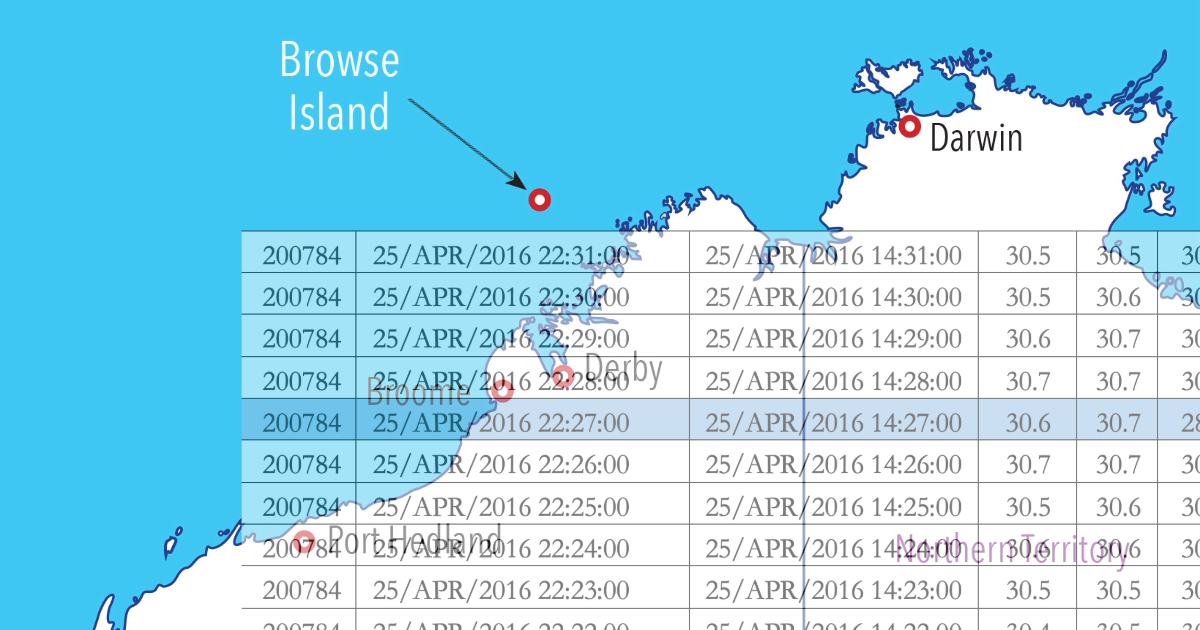
Browse Island (station 200784), 450 km off the Kimberley coast, is one of the most isolated automatic weather stations in the Australian network. It transmits via satellite at exactly 27 minutes past every hour. Request the one-minute data for 19–26 April 2016 and the pattern is unmistakable:
Every hour, on the 27th minute, the AIR_TEMP_MIN plunges by 1.5–2.0 °C while the concurrent AIR_TEMP and AIR_TEMP_MAX remain normal.
A few examples from the 219-page dataset (link below):
- 25 Apr 23:27 – 30.4 / 30.4 / 28.6
- 25 Apr 22:27 – 30.6 / 30.7 / 28.8
- 25 Apr 21:27 – 30.8 / 30.8 / 29.0
- 24 Apr 05:27 – 30.5 / 30.5 / 28.4
- 22 Apr 05:27 – 30.0 / 30.0 / 28.5
The spike is perfectly regular, perfectly predictable, and entirely artificial. It is caused by the momentary drain on the battery as the satellite uplink fires. The reference voltage falls, the probe reading falls, and a false minimum is written into the official record.
This is not ‘noise.’ It is a systematic, hour-after-hour corruption of the data at one of the stations least affected by urban heat or land-use change—the very stations that should be the cleanest.
The same electrical vulnerability was introduced more widely when the Bureau upgraded remote stations to one-minute satellite transmission in 2012. Preliminary analysis from that period showed the delta between the one-minute maximum and minimum increased at many sites once the new power arrangements were in place, and the delta grew as the batteries aged.
These measurement errors are smaller than the wholesale homogenisation the Bureau performs in plain sight, but they are still real, still ongoing, and still ignored. The same ideology that refuses to allow a new diesel refinery in Gladstone (because no bank will even open an account for an oil project) is content to use temperature records known to be electrically unstable to justify Net Zero.
The data from Browse Island is available. The pattern is clear. The only question is whether anyone in a position of authority is prepared to look at it.
 Jennifer Marohasy BSc PhD is a critical thinker with expertise in the scientific method.

One question is whether the bureaucracy will look at it. Another question is whether they will “corrrect” it upwards !!!
Jennifer,
I suspect that it is not only battery instability that will cause such anomalies but wider grid instability. Grids dominated by hydrocarbon powered power plants are the most stable. Grids powered by unstable, intermittent and therefore unreliable wind and solar are the most unstable and have been the cause already of blackouts – Spain being a recent example. I suspect that the anomalies caused by grid instability are more difficult to isolate.
It should be ‘bleedingly obvious’ by now, that the Temperature Data sets and associated ‘manufactured’ ‘averages’ that have produced continuing constant ‘record’ temperature rises in Europe (UK Met Office)– and ‘bogus’ Sea Surface Temperature Rises,(NOAA) preempting a current Super El Nino that has failed to materialise, are part of the vast network of ‘junk science’ that has hoodwinked the public for the last fifty Years,(ever since ENSO and subsequently Anthropogenic Global Warming, left the University Of East Anglia and was ‘exported’ into the Southern Hemisphere and subsequently cemented into the IPCC ‘junk science’ fabric.
There are currently NO Dry Cycle influences anywhere on the planet.
the next Solar-induced Orbital Dry Cycle will start over 140 degrees East Longitude,(West of Melbourne,) and travel East to West at 15 degrees per 30 Day/Night Interval Month, until it reaches the end Longitude of 40 degree W,(Brazil) 180 degrees from the Start Longitude. This will be a One Year Minor Dry Cycle. It will not directly affect Australia to the East of 140 degrees East Longitude.
@Peter Etherington-Smith, are you suggesting the Australian government lay a fossil fuel generated power cable to a small, 35-acre, uninhabited island lying 110 miles north-west of the Kimberley coast of north-western Australia? Just to record weather?
That is clearly not what I said or meant. I was referring to the inherent instability of an electric grid run on renewables where the lack of inertia causes grid failure.
If supply and demand become mismatched – as, for example, because power plants go offline, renewable output changes, or demand forecasts are wrong – the grid frequency will begin to rise or fall. If there is enough inertia, however, this will happen slowly enough that the grid operator can match demand and supply up again and so retrieve the situation.
Inertia is provided naturally and more or less for free by conventional gas, nuclear and hydro generators because they are big, heavy spinning machines directly connected to the grid whose speed of rotation is hard to change. Wind and solar do not naturally provide inertia and can only provide synthetic inertia by reducing the amount of electricity they generate. That reduction is called rationing or in green-speak voluntary adaptation or some such nonsense. Sometimes it results in an actual shut-down – a blackout.
Hence one of the many reasons why so-called renewable energy sources (that actually rely on finite and limited amounts of material) have to be backed-up and rescued from complete failure by coal and gas fired power stations (I leave oil for its more valuable use to provide the thousands of every day items we need and which cannot be easily or economically provided by plants). And no, batteries are not the solution because a) they are hugely expensive and b) there is insufficient material to provide batteries for the whole world.
Kind of irrelevant on what is essentially minuscule, but predictable, anomaly on Gilligan’s Island don’t you think?
https://www.ncei.noaa.gov/access/monitoring/climate-at-a-glance/global/time-series/oceania/land/tavg/1/7/1901-2026?trend=true&trend_base=10&begtrendyear=1901&endtrendyear=2026