
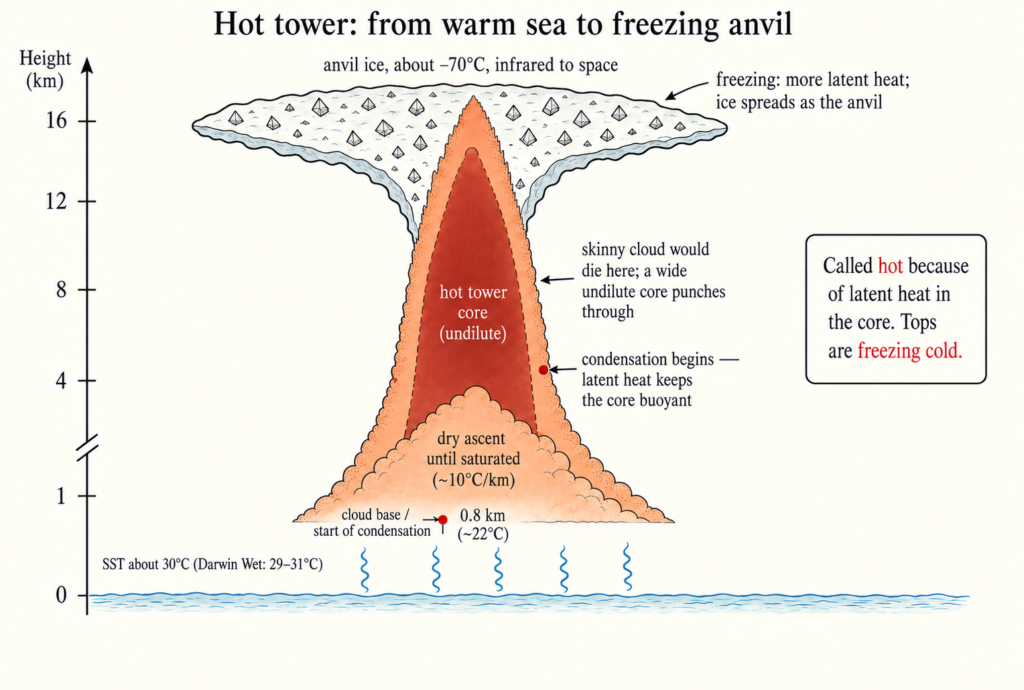
The tropical oceans do not overheat because the surplus leaves by hot towers within cloud bands. Water vapour goes up an undiluted shaft, latent heat is released as it condenses and freezes, and the icy roof radiates to space.
Nothing is trapped. Of course water vapour is a so-called greenhouse gas: a radiatively active gas. It is more abundant than carbon dioxide in the atmosphere, and it absorbs across more wavelengths.
Metaphorically speaking, these hot towers smash through the glass ceiling of the Earth’s atmosphere because they extend beyond the Troposphere.
Hector, the afternoon storm over the Tiwi Islands, visible from Darwin and often 20 kilometres high, is that chimney with a timetable. The official IPCC climate-models all grid average it away, Hector can not exist using the tools of this dominant paradigm that is based on a predominantly radiative model of energy movement within the atmosphere. There model is fake; it doesn’t pass the most basic test — it does not have space for the most important structure for moving energy within the atmosphere: hot towers with their chimneys of ice.
Plank 1 of my new Climate Resilience Theory takes a different approach, it has a different starting point. It begins with the hot towers.
My hypothesis, and some fair tests of its utility are archived here, you can begin with the Q&A. Alternatively, there is my first blog post that provides context with a summary and more information about Hector the Convector. You can leave a question at that blog post.
 Jennifer Marohasy BSc PhD is a critical thinker with expertise in the scientific method.