IF you believe Australia’s Climate Commissioner, Tim Flannery, it is getting hotter and hotter in Western Sydney.[1]
But scientist Basil Beamish noticed that in the Climate Commission report they only show the trend of the number of hot days from 1970-2011. There is data for Sydney, measured at Observatory Hill, back to 1890.
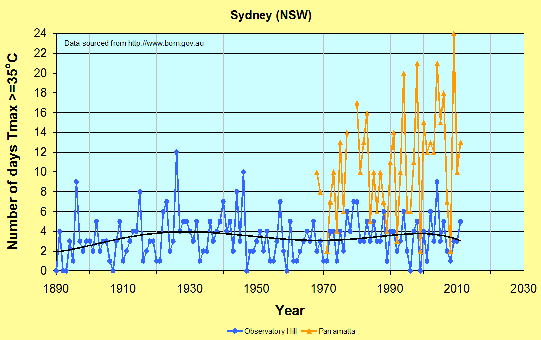
Dr Beamish noticed that if you use all of the hot days data back to 1890 it is clear there is a different long-term pattern in play (see blue line in chart). In fact the year with the greatest number of hot days for Sydney is 1926 (12 days) and this has not been beaten since.
But instead of reporting on the long term trend for Sydney as measured at Observatory Hill from 1890, Professor Flannery has chosen to just focus on Western Sydney and in particular use only the data for Parramatta North (see red line in chart). This data set begins in 1970, which was a low point in the hot days cycle. By choosing Parramatta and beginning in 1970, Professor Flannery can make the upward trend in hot days look dramatic.
Parramatta is further inland than the Observatory Hill site and so the summers are warmer and the winter’s colder. But if there were data for Parramatta back to 1890 it would almost certainly show the same pattern as Observatory Hill. Indeed it was almost certainly hotter in Parramatta, in Western Sydney, in 1926 than anytime since.
Once again the observational data does not support the nonsense claims made by Australia’s Climate Commissioner, Professor Flannery.
******
Basil Beamish provided the chart and many of the words. Thank you.
1. http://www.abc.net.au/news/2012-05-14/heatwaves-bushfires-predicted-to-hammer-nsw/4009006
 Jennifer Marohasy BSc PhD is a critical thinker with expertise in the scientific method.

We are observing the Big Lie in action. We thought it was just a fascist or totalitarian thing. But it is not. It is a standard political thing. Only the internet and blogs like Jennifer have let the general public see how manipulative are those who want to do what the rest of us don’t want them to do.
That’s right, Doug. Here’s something they shouldn’t forget.
From the First Fleet Journals, summer 1790/91:
“at Rose Hill [Parramatta], it was allowed, by every person, to surpass all that they had before felt, either there or in any other part of the world…it must, however, have been intense, from
the effects it produced. An immense flight of bats driven before the wind,
covered all the trees around the settlement, whence they every moment
dropped dead or in a dying state, unable longer to endure the burning state
of the atmosphere. Nor did the ‘perroquettes,’ though tropical birds, bear it
better. The ground was strewn with them in the same condition as the bats.”
Grasping at straws there eh guys? Indeed you should pick on the tiny details because the big picture is certainly out of whack with your climate delusional narrative.
Is there no legal recourse to these blatent deceptions.
“But if there were data for Parramatta back to 1890 it would almost certainly show the same pattern as Observatory Hill”
Why? and not necessarily
– the issue is the distance sea breezes penetrates inland. There’s no basis for suggesting trend is not real.
And ongoing land use change in the Sydney basin is another local microscale issue – Pitman et al.
But what is their end game by trying to scare everyone with this UHIE nonsense? We can accurately say that there is zero we can do to change the climate now or into the future, so what are they on about?
If it gets warmer or cooler we’ll just have to adapt and the very last delusion we should be grasping and wasting billions on is a co2 tax. Clearly we are going to waste billions every year for a zero return. So why are we doing it, clearly Juliar and her govt couldn’t care less about increases in co2 emissions. They are happy to export millions of new tonnes of cheap coal overseas, but hate Aussies using this cheap energy here in OZ.
I’d say from the above records that there may have been only small temp increases and some UHIE.
Amazing – no hockey hstick – must be somthing wrong – please adjust so we can see a warming trend, cant let the facts get in the way of a good scam.
Don’t worry guys. I suspect no-one outside Fairfax and the ABC is listening. The public has turned off to these ravings. Especially, ironically, in Sydney’s west. To put it politely, Professor Flannery has a severe credibility problem, which is probably why Professor Steffen did most of the talking at yesterday’s press conference.
That horrific late summer of the First Fleet involved north-westerlies, a rare thing, but one of the worst of all possible climatic events in eastern Oz. And in February! Tench mentions that there were no measurements for Rose Hill, but they recorded the Sydney heatwave earlier in that summer thus:
“At 9 a.m., 85 degrees. At noon, 104. Half past twelve, 107½. From one p.m. until 20 minutes past two 108½. At 20 minutes past two, 109. At Sunset, 89. At 11 p.m., 78½. [By a large Thermometer made by Ramsden, and graduated on Fahrenheit’s scale.]”
When the February Rose Hill events occurred, Sydney measured about a degree cooler than it did in the earlier heatwave. The north-west wind was the killer ingredient. It was a dry heatwave, such as occurred in the early eighties (I forget the year) and around Xmas 2000. Judging from the descriptions of mass wildlife deaths, the 1791 event was much worse than those more recent ones. Of course, it could happen again, and without efficient, cheap energy from modernised coal power generation, the cost will be extreme.
Tench and Dawes were remarkable men, extremely conscientious about both measurement and observation. Amazingly, Tim Flannery is editor of Tench’s journals. Flannery is an unremarkable man, conscientious about nothing.
Check out
http://wattsupwiththat.com/2012/05/14/flim-flam-flannerys-fecklessness-foiled/
(and http://wattsupwiththat.com/2012/05/14/quote-of-the-week-death-by-coochey-coup/ while you’re there)
Luke,
I was checking the Observatory Hill temperature data against temperature data for sites in coastal and inland Queensland about a year ago and the match in terms of general pattern was surprisingly good.
So John Abbot and I ended up using the Observatory Hill temperature data as an input into our neural network model for rainfall forecasting for all Queensland sites as you will see when our paper on the same comes out in July.
So, in short, the Observatory Hill temperature data is probably not only a good indicator of past temperature trends in Western Sydney, but also for anywhere along the east coast of Australia. It is the longest continuous high quality record.
The timing of the Flannery et al announcements are always well timed to fit into the Government’s agenda. After all the Commission is nothing more than an extension of the Gillard PR team.
Flannery would like us to believe that the Carbon Tax is a small price to pay to stop the apocalypse!
Luke, kd (and Bazza if you’re around)
Are you able to explain again why you are so adamant this about science?
I still wish it was but, the further we head down this track, the less likely that seems to be.
Luke….of course the further inland you go in these temperate zones….the higher and lower the temperature ranges….I know you don’t need me to explain why that’s the case….and yes….sea breezes are part of the reason.
Actually that’s a rather general trend everywhere is it not????
Even in the stated timeframe that has been used….you can see that on the above graph re max temps…maybe Jen can source one with the min temps as well?
While there may sometimes be deviations, that is the general trend….
BTW…no argument about local influences….none….
Coz Debs – scientists like to argue. We just don’t say yes to everything dropped under our noses. And sceptics have a habit of concocting nonsense at times (IMHO and with respect of course) Would you like a list?
In fact Wattsy would list Observatory Hill as a compromised site.
Yes well …. ahem … high quality?
http://wattsupwiththat.com/2010/06/12/art-horn-a-remarkable-statement-from-noaa/
http://wattsupwiththat.com/2008/07/02/sydneys-weather-station-150-meters-makes-all-the-difference/
Luke,
I think that is actually a fair accusation if you apply it to both ‘sides’ of this debate….Surely you can’t think that the stuff that 2 of our climate commissioners sprouted in the media yesterday was anything but ‘concocting nonsense’?….and it was definitely masquerading as ‘science’… and… there is an equally long list of similar examples (IMHO).
Would also like to point out that business people are not inclined to say yes to everything dropped under our noses either….and that is not specific to science based things but most definitely includes them.
Also….not sure you actually answered my question but it has caused me to ask another one.
If scientists like to argue….and it’s quite obvious that in this particular branch of science there is plenty to argue about (IMHO)….how is that ever going to be a good basis to develop social policy with ‘risk management’ as it’s justification?
Sorry…that’s a bit overly rhetorical….but…. we’re dealing with so much rhetoric that it’s a bit hard not to do it when replying.
There is a huge difference between Observatory hill and Parramatta. One is surrounded by water, which as we know greatly moderates the climate.
Nigel,
The water moderates the climate. I state this clearly in the post:
“Parramatta is further inland than the Observatory Hill site and so the summers are warmer and the winter’s colder. But if there were data for Parramatta back to 1890 it would almost certainly show the same pattern as Observatory Hill. Indeed it was almost certainly hotter in Parramatta, in Western Sydney, in 1926 than anytime since.”
Is there any reason why the pattern/the trend would change?
As I explained above in a note to Luke, Observatory Hill is a good proxy for the temperature pattern at an annual and also decadal scale for both coastal and inland sites in Queensland, so why not also Parramatta?
It is not possible to assert that ‘if Parramatta data was available from 1890 it would almost certainly show the same pattern as Observatory Hill.’ In the absence of real data,such a high confidence cannot be claimed. You fall into the trap that you claim has captured the CC.
Over 120 years,Observatory Hill’s temperature trends will be a somewhat better analog of other hill sites within 10km of the sea on the east coast of NSW than it will be with sites that have experienced transition from rural to urban characteristics 40km from the sea.
Andrew Bolt has asserted that the Climate Commission has picked cherries. However,the argument he attempts is simply more cherry picking:he cites The Australian,who clearly will not compare apples with apples when they introduce Blacktown Airport data into the ‘discussion’. The Oz’s journos do not compare trend,but simply blurt that there are overall fewer Very Hot Days at Bankstown than Parramatta for the period 1970-2010. Interesting, but irrelevant.
But when you make the effort to compare the actual trends at Bankstown,and at Prospect Reservoir,with Parramatta,it is clear that they are similar. So we have three forty year records that agree in TREND for VHDs in western Sydney. There are more in the period 1990-2009,than in 1970-1989.
The Oz also seems to think that comparing five year periods within the total forty has some relevance to the long term trends and suggests ‘proof’ of the CC’s duplicity. This of course is more diversionary nonsense,and another sad example of journalists overestimating their abilities.
PS I would be interested to know how good the Observatory Hill data is as a general indicator of global temperature trends?
If one uses Prospect Reservoir, then there is a big increase between 1971-1980 and the last decade (93 days of +35C compared to 143). Compare this to Sydney Ob of some 40 days of +35C during the 1970s, down to 35 between 2001 and 2010. So there is no real pattern visible here. Or do we have selective CO2?
The 1970s were mainly La Ninas and neutral conditions – I don’t think there was a major drought during that period.
This decade was mainly dominated by El Ninos, thus culminating in a major drought – as severe as the Federation and Second World War drought periods. So to compare these periods with each other temperature-wise is not very helpful and for the BOM to use that start point is misleading. As Basil points out above, the longer record gives us a much better picture of the climate patterns.
Yet this decade was the second wettest decade since 1900 with the 1970s being the wettest.
So what we seem to have is no real patterning of climate – climate does what climate does.
It’s interesting to note that this report (which is partly concentrating on western Sydney) has just been released before Flannery’s talk in Parramatta.
Jen
Can someone get your/Basil Beamish analysis out to those who may attend the Parramatta meeting?
Can Luke send it to Tim Flannery and other government employees?
Can everyone send it to The Australian newspaper and their favourite newspaper?
“Once again the observational data does not support the nonsense claims made by Australia’s Climate Commissioner, Professor Flannery”
Using the available observational data from Observatory Hill (Dr Beamish’s preferred location) and comparing the 30 year cohort 1911-1940 (which includes the notable year 1926) to the 30 year cohort 1981-2010, we find that average mean maximum has increased from 21.7 to 22.5. Notwithstanding Dr Flannery’s tendency to run-off at the mouth (and it IS a very annoying habit), I would have thought the data is largely supportive of his claims. Still, one good cherry-pick deserves another.
Comparing the two data series for the same 43 year period, it appears that there is slight shift in the ratio of hot days at Sydney Observatory to hot days at Parramatta. As you suggest though, the observed shift does not warrant the claims made by Climate Commissioner Tim Flannery.
Whether the CC is right or not,there is no sense in critiquing them with even less data. Ian,you are repeating the fudge of looking at segments of the data,as the Oz did with 5 year period comparisons. Use the forty years or nothing. That’s what the CC did,whether it’s truly adequate or not. Of course at shorter scales the numbers on extremes only show the underlying variability of occurrence of an extreme like a VHD.
You can also splice together the last forty years out at Richmond RAAF to get a somewhat similar trend,though some critical summer days are missing. While I agree that forty years ain’t as good as a longer record,it’s the best they can supply it seems.
As high-qual sites both Richmond and Obs Hill show a trend of increasing temperature since the 1940s.
BTW,while Flannery will be talking on the report,he did not author or co-author it,despite what was strongly implied by media coverage yesterday.
Government & official bodies worldwide have been picking so many prunus avium berries, children just won’t know what a cherry is.
I’m confused – in the UK we have a “Department for Energy and Climate Change” (DECC). Now, the Department for Education is clearly in favour of education, and the Ministry of Defence is clearly in favour of defence, so can we conclude the DECC is in favour of both energy and climate change?
I use Google News a lot, and from news reports about the future (many claim current) threats from sea-level rise, drought, flooding, the risk of temperature increases over the so-called “official guardrail” of 2°C, ordinary folks, the ones at the sharp end, and I mean by that those who are paying for their governments stupid energy policies and crazier regulations, are getting just a little tired of it all.
They don’t know much or indeed very little about Michael “lonesome pine” Mann or Tim “65 metre” Flannery, and “very likely” nothing at all about the IPCC and its selective reports, but they have long memories. Most can see that despite all the huffing and puffing and “could” and “may” and “might” of the impending disaster reports, weather and climate haven’t changed much in their lifetimes, and that in reality, little is changing now.
The final demise of the entire alarmist “house of cards” won’t be triggered by sceptics beavering away identifying statistical tricks, unsubstantiated conclusions and “cherry-picking”, but by all the little people, those whose views are ignored, those who are talked down to daily. Those who have to have things explained to them with charts so big a stepladder is needed, because they’re seen as too stupid to realise the extent of the looming catastrophe. It’s the “little people” who pay most of the taxes which fund those lecturing them, and so fund research to see if trees will respond negatively to CO2, or to “prove” that the Great Barrier Reef is “doomed”. They pay to fund governments who respond by screwing more money still out of them.
They’re not too stupid to realise that a tax designed “to make the polluters pay” will make THEM pay. Power companies, service industries and manufacturers don’t pay for anything, all they do is pass on some of their customers’ money, the “little peoples” money. They are getting just a little bit fed up with it all, and their disbelief and anger are growing. They don’t like being taken for granted, and they don’t like being treated as “cash cows”. The revolution is coming, and we sceptics may be doing little more than open the eyes of the so-far “silent majority”.
When the question is asked in the future “what did you do in the climate wars, daddy?”, the answer may be quite simply “I spoke the truth”. At the moment, it’s all we can do. In the end, it’s enough.
“I spoke the truth” – yea well.
“I spoke the truth” – yea well.
Try it – it’s painless, costs nothing, and results in a feeling of satisfaction.
If you look at a place where okay records have been kept for a few centuries, it helps to bring some commonsense to the notion of trends.
To live in England in the first half of the eighteenth century was to grow familiar with drought. To live in the latter half of that century meant living with rain, rain, rain. And there would be plenty more of that till the Great Blight of the 1840s, where cold and rain together created mass starvation.
The good thing about living in those climatic times was that they coincided with The Enlightenment. Though there were almanacs, religious fanatics, weather theories and the like, few in the higher levels of government and academia were rushing to false understandings of climate. Certainly, nobody proposed controlling climate through taxes or vast shifts of money across the globe. For all the inhumanity, neglect and bungling of agricultural policy, the persistent dries of the early 18th century and the frequent wets which came after were not made worse by spending and planning according to the pronouncements of record-keepers finding “trends”.
Let’s burn coal and gas efficiently in modern plants, let’s have cheap abundant energy and get rich. The best answer to bad weather is wealth – but not in the pockets of charlatans and mountebanks like Flannery and Gore. Let’s have us a civilisation.
Rabitoh and Polyaux,
That is in a lot of ways precisiely the problem. This work is so open to cherry picking because everyone is so focused on proving something about the future climate (and I’m even starting to get confused about what we are trying to prove)
I can see how rabitoh has arrived at that figure….which is .08 average mean maximum rise in 30 years.
I would also like to know how a similar calculation would look if we averaged the mean maximum of cooler events as well….would it be higher/lower than .08?
And even if we could say that is a ‘consensus’ figure….there are still some enormous un answered questions.
If that .08 figure is correct ….
1) Is it caused by rises in C02 or by human activities?
2) Does it pose the sort of risks/dangers that some of our CCs were highlighting yesterday like a 1.1 metre rise in sea level that would wipe out the named property and infrastructure (and apparently make people in the western suburbs crankier when they’re stuck in a traffic jam)?…and…sorry…. I can’t help asking whether people in Western Sydney would not gain an advantage out of that as they could possibly own the new coastal property??????
3) What is the best way to manage those risks?
The only thing I see on the table is a plan to create a carbon tax/price/ETS etc that has as its justification a gobal plan to stop the climate from changing?????
Is that a good risk management plan?
I think the trend is somewhat similar to the Post Office in Gayndah in QLD
http://www.bom.gov.au/jsp/ncc/cdio/weatherData/av?p_display_type=dataGraph&p_stn_num=039039&p_nccObsCode=36&p_month=13
Nothing to see here so the scaremongers can take their nonsense somewhere else !!
Polyaux
What I tried to say is that both 5 years and 40 years don’t tell the full picture. Many of our weather stations do not have enough historical data to detect true CC. They detect a short trend only.
For instance, there has been more rainfall Australia-wide over the post-1950 period than pre-1950 period. If one just looked at the last 40 years (since the 1970s), we have trended down in overall rainfall.
One area that does seem to be actually declining in rainfall is SW Australia. It may take another 100 years to see if this is CC or a trend.
Now now Tony – onanism is also painless, costs nothing, and results in a feeling of satisfaction.
I have a threshold test to see if you’re having a lend of yourself – if you invoke Galileo you lose. And if you think sceptics are on a truth crusade you also lose.
If you believe everything Tim Flannery tells you – well you’re open to suggestion and gullible. Tim does his best.
Debbie – somehow I think this does say something http://www.bom.gov.au/cgi-bin/climate/change/timeseries.cgi?graph=tmean&area=nsw&season=0112&ave_yr=0
Why get upset – Abbott will be in any day now and it will all seem like a bad dream. Fear not.
Maybe, Luke, if some of the higher temps had not been adjusted down by up to 0.7C prior to 1950, we may have a slightly different graph. Check the difference between actual data and the readjusted High Quality data the BOM produces.
Luke,
What does it say in relation to my questions?
It is a BoM graph for NSW/ACT with the cools and warms and clearly shows the influence of the dominant Ocean Currents for most of the start of this century.
Is it identifying a C02 risk that we have to manage?
Why would an Abbot led Govt give me any comfort?
Bad dream?
And I’m not particularly upset….just completely over the obsessive behaviour re the climate.
Robert, 15/5/12 at 9.39 am.
Thanks for those earlier 1790 Sydney summer temps. I doubt “mild” temps like 109 f would kill birds or bats. The only time in my life as a keen bird observer that I have ever seen a bird die in flight from heat was in Sturt’s Stony Desert in the ’50s when it was 122 f in the shade.
I suppose you could argue that coastal birds would not be as used to extreme heat as western birds so it would need less heat to kill them but I think you could estimate the temp that day at Parramatta to be at least 115 f [46+c].
In the Melbourne heatwave of 2009 I was at Mount Waverley one afternoon, I think it was about 44C. I didn’t see any birds but there possums lying under trees and in doorways seeking any shade available. They were so hot that you could approach and pick them up without a struggle. We gathered what we could find and put them in a cool place with water. they all recovered. Although it wasn’t extremely hot that day it was the fourth or fifth day of 44C in a row. I think the constant heat got to the. Maybe that’s what happened to the birds in 1790
Luke,
Finally get a chance to reply to your earlier post. You make some valid points re- extrapolation, but your response works both ways. The records for Sydney Airport go back to 1940 and the trend in the number of hot days for that location closely follows that of Observatory Hill. Of course the only way we could confirm one way or the other would be to have records for 1926 for Parramatta to confirm that the number of hot days for that year exceed the more recent records of the last decade. Such is the issue of working with real data and not modelled values.
Bob,
The Gayndah plot you refer to is for Tmax not the number of hot days. However, I have plotted the number of hot days for Gayndah and again it shows a similar long term trend to Observatory Hill in Sydney. The same can be said for Charleville, Richmond, Emerald and Brisbane. Linear trending means very little as it depends on the starting point that is used. I think this decade will prove very interesting in terms of the number of hot days as all the indications are for a general decrease.
You are correct Luke. It is not something I am looking forward to but Abbott or a drovers dog will soon be running the country. And I will be there swinging my baseball bat as vigorously as any far right extremest to get this outcome. For there comes a time when governments have to be chucked out or indeed annihilated for their longer term good and the good of the country. Blind freddy can see we have reached such a point in our history once again. The present mob, by all their shenagigans to stay in power, have forfeited any legitimacy and moral high ground. And these words are coming from one who first letter dropped ALP ‘How to Vote’ cards in the 1947 Qld State Election, who stayed loyal to the ‘Light on the Hill’ through the ’57 Split and the dark years of Bjelke-Petersen and who joined the true believers on the grounds of the old Parliament House in Canberra in 1975 burning a candle ‘to save democracy’. One can forgive oneself for supporting incompetency, assuming the heart is in the right place, but when the government relies on lies to stay in power it is definitely “time for a change”.
The trend in house prices in Brisbane showed a decrease of 8% on average last year
My financial adviser, Tim Flappery, told me I should wait for another 10 years to buy a house as he has proof that I will be able to buy a house for about 20% of present values.
He also told me that the ASX dropped about 1% today. If I wait for exactly 150 days I can buy
BHP, Rio Tinto and Santos for less than $100! – thats the entire three companies not just a share in each.
That Tim is a pretty smart cookie! He works it all out with models and trend lines.
“It is a BoM graph for NSW/ACT with the cools and warms and clearly shows the influence of the dominant Ocean Currents for most of the start of this century”
Huh? I dunno Debs – it simply shows an unambiguous warming trend. That’s it.
and in extremes hottest days are up and coldest days are down – isn’t this all fitting together for you? http://www.csiro.au/en/Outcomes/Climate/Understanding/State-of-the-Climate-2012/Temperature.aspx
Bob Massey – but see http://www.bom.gov.au/jsp/ncc/cdio/weatherData/av?p_display_type=dataGraph&p_stn_num=039039&p_nccObsCode=38&p_month=13
That’s where the Gayndah warming story is – in the minima
One of the problems with the orange line on the graph is that there are apparently large fluctuations from one year to the next. I have looked at the raw data and this is in part because the chosen time interval. A calendar year splits the summer period where you get all the very hot days. Better to plot out the number of hot days for each summer period. Best to replot the line and look again. Of course, there is still a major problem with trying to say anything meaningful about climatic change from a very short time interval such as illustrated here. Its the same with rainfall – if you just look at a carefully selected couple of decades, the impression you get can be very different from examining a century or longer.
Ah! Another example of the fraudulent Hayhoe Curve.
http://notalotofpeopleknowthat.wordpress.com/2011/11/25/whats-katharine-hiding/
check this out
http://users.tpg.com.au/johnsay1/Stuff/Observatory_Hill_Full_Adjustments.png
Luke,
it didn’t answer my questions.
It was a graph that shows an unambiguous warming trend (if you would prefer that description) in NSW/ACT.
The CSIRO graph &report is similar.
I thought my questions were about risk management?
Abbot also explains another problem with time intervals that are somewhat unrealistic because they don’t recognise seasons only calendar points.
It is all still just a useful tool.
If we’re attempting to manage risk, it is only one tool and it’s not conclusive or exclusive or ‘settled’ enough to be used in the manner it has been used.
Thanks John. You’d wonder why that site would need to be adjusted upward for its mean max.
You’re just cherry picking and nit picking Debbie. If you don’t get it by now you never will.
What am I not getting Luke?
What precisely is ‘IT’ ?
What am I specifically cherry picking and nit picking?
I’m not a regular reader but it’s been pointed out to me that in this article, the author postulates that the urban heat island effect (UHI) doesn’t exist.
I’d be interested in reading more about that. Maybe a follow up article by Dr Marahosey or Dr Beamish would be handy. An article by a climate scientist with expertise in global surface temperature trends would be even better.
My understanding is that as urbanisation increases the surface temperature goes up disproportionately to surrounding areas. Once the urbanisation stabilises the rate of increases also stabilises. This has been observed or postulated going back decades in the literature (Google scholar has papers going back to at least the 1960s that discuss the urban heat island effect, and it’s been accounted for in all the global temperature data sets for years).
Could someone point me to another source of information that, like the article above, shows that the UHI doesn’t exist after all?
Thanks.
“You’re just cherry picking and nit picking Debbie. If you don’t get it by now you never will.”
… and neither will anyone with a firm grasp on reality and not climate models, on unjustified conclusions, who don’t accept the never-ending recipe of “high end” scenarios, who don’t orgasm over every doom-laden prediction. “Summer ice [may|could|might] be gone by 2012”. It’s 2012 right now, try swimming to the North Pole.
Last year, some crackpot “researchers” announced that thousands of species that haven’t yet been discovered have already become extinct. Beat that for sheer nonsense.
No, we DON’T get it, because there’s NOTHING to “get”. We’re told that pine-forests are dying out because of “climate change”, yet in the small print at the bottom is mentioned, just mentioned, bark beetles, rust and forest mismanagement leading to more dead trees for the beetles to breed in, and fires in uncleared brushwood.
The Great Barrier reef is “doomed” because doom-merchants have checked a few hundred sq. metres and found some bleached coral, because the oceans are “acidifying”, when 99.999% of their area is unexplored, let alone studied, and when pH changes several time the “tipping point threshhold” occur daily. The GBF has been “doomed” many times over the past decade. Some scientists have very short memories. How convenient.
Researchers clinging to grants submit coral polyps and fish to extreme conditions of acidity (hydrochloric) and temperature, imposed suddenly, studied for hours or days, and “predict” the future in decades and longer. Long-term studies by hard-working “real” researchers show just the opposite, that stress and mortality initially increase, but offspring carry forward the resistant genes of their parents who survived. They (the real researchers, not the fauna) are ignored by the media, by alarmists in general, and the other worthless short-term studies are hailed as “conclusive evidence”.
The only thing that’s conclusive is the level of gullibility of unthinking and credulous “does my carbon footprint look big in this?” greenies, so-called environmentalists who love everything natural except mankind, who want and need to believe the worst, want to believe that mankind is to blame for everything from rain to drought to earthquakes and tsunamis. “I’ve seen the enemy and it’s US!” – well they’re right about that at least, THEY ARE the enemy. Enemies of human advancement, enemies of progress. enemies of reason and the getting of knowledge.
From a friend who’s done his research regarding the GBR: “Actually, the Barrier Reef authority’s own data show that there has been no statistically-significant warming of the seas surrounding the reef in the past two or three decades, so, even if the reef were in decline, global warming could not possibly be the cause. And so-called ocean “acidification” could not be the cause either, because every time the Brisbane River floods, as it did eight times from 1840-1900 and only four times since, vast quantities of rainwater (strongly acid, with a pH of just 5.4) pour into the ocean within the reef, which has nevertheless survived.”.
Sou,
I am not sure how you came to that conclusion or the person who pointed it out to you did. The plot shows exactly the opposite. The Parramatta situation is totally dominated by the UHI effect in this case, which is what some of the other bloggers have been pointing out and several people have commented on to me personally with their own analysis of other NSW sites. What we are saying is that there is an underlying natural trend in hot days (the observable long term trend shown by Observatory Hill and many other sites in NSW and Qld with century old temperature records), but in this case for Parramatta superimposed on that is the exaggerated localised UHI effect. It is just unfortunate that the Parramatta record is not long enough to show the complete picture.
Also please note the Koala’s post from yesterday re-emphasised the point of time perspective. I well remember the “Global Cooling” theory of the 70’s being matched to the drop in temperatures for the previous 30-40 years. It was flavour of the month at nearly every Uni. Then we had the “Global Warming” theory as shown in the Koala’s plot and that is how we end up where we are today. Too many people look at things within their own lifespan and lose sight of the bigger picture. Cause and effect still has a long way to go on this one.
By the way not sure if you are having a go at me on the climate scientist bit, but believe it or not I have some background in that area. I studied and obtained an honours degree in Geology, when Geology was still called Geology and not the softer version Earth Science. I was privileged to have been taught by the late Professor Samuel Carey who always taught us to question everything and if the theory doesn’t fit the observational data then look for a new theory. I have found this a very useful strategy throughout my professional career.
cheers, Basil
The ABC page links to the links to the overall report, not the NSW report, which is here:
http://climatecommission.gov.au/wp-content/uploads/NSW-report_final_web.pdf
Population growth in Parramatta has outstripped that for Sydney as a whole – not an insignificant statistic IMHO.
http://www.parracity.nsw.gov.au/__data/assets/pdf_file/0019/103456/Parramatta_Population_Growth-fact_sheet.pdf
Dunno where “sou” gets his impressions from. The CC/NSW report describes it in detail, and the ABC report doesn’t mention it (surprise?).